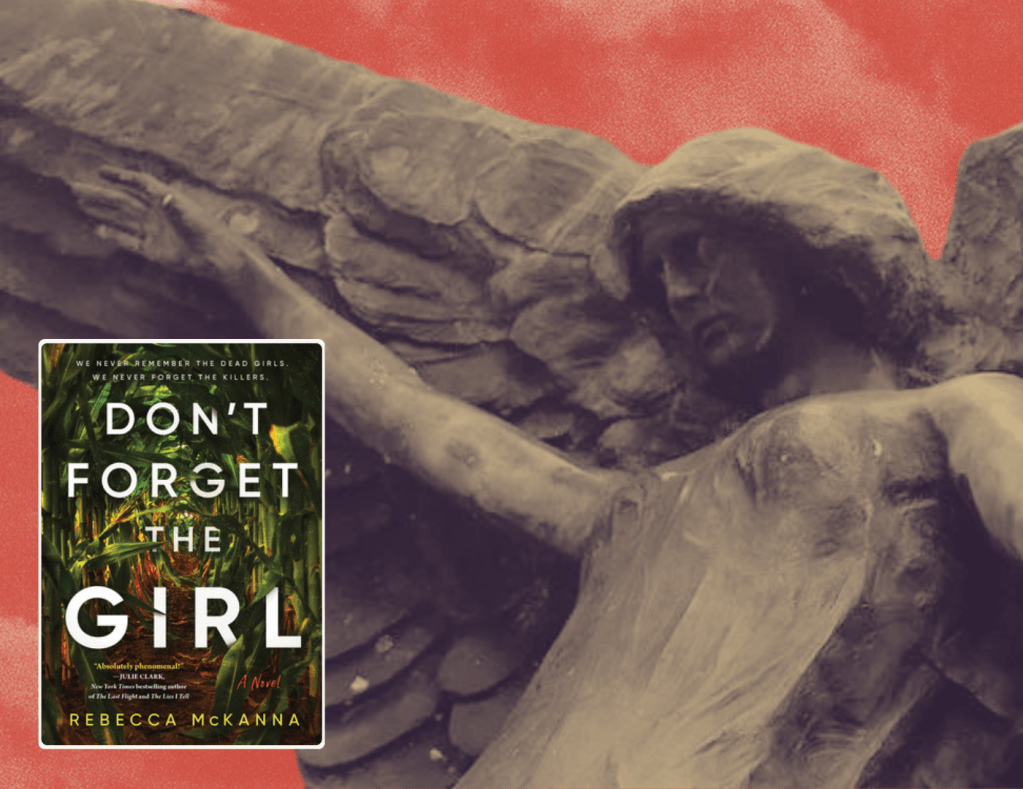
This weekend, I am excited to be in conversation with novelist and friend Rebecca McKanna at Second Flight Books in Lafayette, Indiana. Her first novel Don’t Forget the Girl is a thriller about friendship, shame, and victim narratives. The story takes place in Iowa City, Iowa. I highly recommend it.
A key location (and possibly character) in Rebecca’s novel is the Black Angel of Oakland Cemetery in Iowa City. The cemetery, close to the college campus of The University of Iowa, has many legends, especially since it turned black from its original copper.
Like true crime, the origins of local legend can become muddled by salacious and unfounded changes. I will share Teresa’s story and the legend that led it astray.
Where did the Black Angel come from?
The Black Angel of Oakland Cemetery is about 8 feet tall, standing with wings spread. The statue, due to the elements, is now black-ish green. Due to her legendary status, she has been the victim of vandalism and is missing fingers.
The Angel is a memorial for Eddie Dolezal, who died at 18 of meningitis. His mother Teresa Dolezal Feldevert (born in 1836) moved from Strmilov, Bohemia to Iowa City, staying until her son’s death in 1891. A practicing physician in Strmilov, Teresa served as a midwife in Iowa City.
A tree stump monument was erected at Eddie’s grave in Oakland Cemetery.
Teresa moved to Eugene, Oregon, married Nicholas Feldevert, and was widowed in 1911. She moved back to Iowa City and hired artist Mario Korbel to create an angel to look over her son and husband’s remains. This endeavor did not go as planned.
She paid $5,000 for the monument, which was completed around 1912. Some publications say she was not pleased with the work as it did not incorporate her son’s stump monument. Other publications say the memorial was made of poor quality stone and covered with only a thin layer of bronze. Regardless of the details, Teresa was not pleased but had her son’s remains and stump moved next to the Angel anyway.
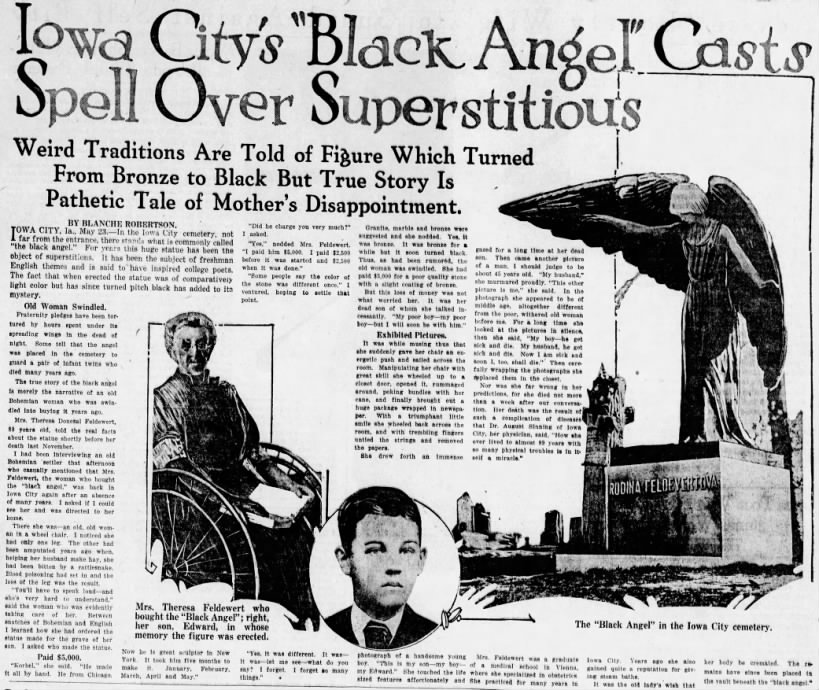
Shortly before her death, Teresa was interviewed by Blanche Robertson for The Des Moines Register. Teresa, then 89 years of age (pictured above), held pictures of son and husband, telling the interviewer: “My boy—he got sick and die. My husband he got sick and die. Now I am sick and soon I, too, shall die.”
She died on November 18, 1924 and her ashes were buried under the Angel.
Why did the statue turn black?
A logical Chelsea (my favorite character) explains the Black Angel’s appearance in Don’t Forget the Girl: “It’s bronze. It oxidized over the years, which gives it that greenish-black color.”
But such a scientific explanation will not suffice when one needs a scary thrill in a cemetery. According to legend, there are several reasons for its discoloration.
- Teresa’s evil sins caused the Angel to turn black. Some versions say she was a witch.
- The night after Teresa’s burial, the Angel was struck by lightning.
- A boy was buried under the Angel. It turned black because his father, a preacher, had murdered him.
- Teresa’s husband buried her and promised to remain faithful to her. He found a new sweetheart and his lie caused the color change.
- Or, a man had the statue erected over his wife’s grave. Her infidelity during life turned it black.
What is the lore surrounding the Black Angel?
Touching or kissing the angel has become a rite of passage for the local coeds and youths.
- Anyone who kisses the Angel will die instantly.
- If you touch the Angel at midnight on Halloween, you will die within seven years.
- Any girl who kisses the statue (or kisses near the statue) in the moonlight will die within six months.
- If a virgin is kissed in front of the statue, it will turn to it’s original color (breaking whatever curse).
- If you stare into the Angel’s eyes or touch her, you will come down with an incurable illness.
- A pregnant woman will miscarry if she touched it.
- It turns a shade darker each Halloween.
As you can see, the tragedy of Teresa has now become something much more sinister. Not only has the memorial been damaged, but her reputation as well. As I always say about cemetery lore, enjoy the legend critically but treat interments respectfully.
Sources
The Black Angel Monument. www.iowa-city.org. Pamphlet.
McKanna, Rebecca. Don’t Forget the Girl. Sourcebooks Landmark, 2023.
Moran, Mark and Mark Sceurman. Weird U.S.: Your Travel Guide to America’s Local Legends and Best Kept Secrets. Sterling Publishing Company, Inc., 2009.
Robertson, Blanche. “Iowa City’s ‘Black Angel’ Casts Spell Over Superstitious.” The Des Moines Register, 24 May 1925, p. 19.

 Notebook of Ghosts
Leave a comment